
* This article was translated from Macedonian with the help of artificial intelligence (AI).
A doctor’s office is full of unfamiliar people, sounds, smells and touch, and often long waits too. It’s no surprise that for many children on the spectrum, a visit to the doctor or dentist is one of the hardest moments. The good news is that preparation can help a lot. Here is what has helped many families.
Why it is so hard
Raising Children Network, Australia’s national parenting website, explains that many children on the spectrum have difficulty with communication, prefer predictable routines and have sensory sensitivities. At the doctor’s, all three come together at once:
- Unpredictability. The child doesn’t know what will happen, who will touch them or how long it will take.
- The senses. A bright light above the chair, the sound of the dental drill, the smell of disinfectant, cold instruments, gloves.
- Waiting. A full waiting room, noise, people coming and going.
- Touch. An examination requires closeness that many children find uncomfortable.
Once you know what is hardest for your child, it is easier to choose which of the tips below to try.
Before the visit
1. Play “doctor” at home
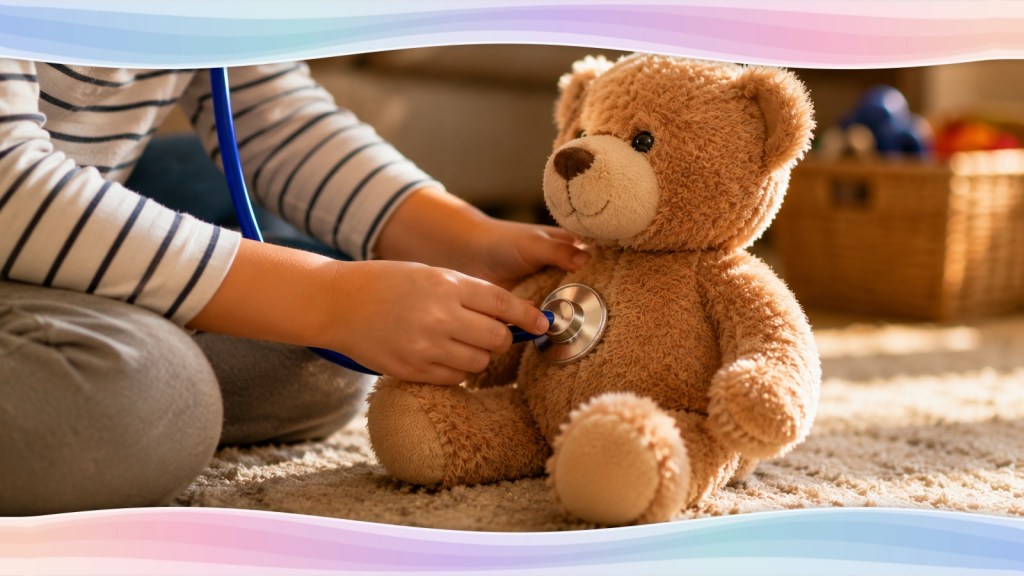
With a toy stethoscope, a spoon instead of a tongue depressor, a small torch instead of the light. First “examine” the teddy bear, then you, then your child if they want. That way every step becomes familiar: open your mouth, take a deep breath, show me your ear. SA Dental, the public dental service of South Australia, recommends this too: take turns being the dentist and the patient, and use simple things like a mirror, gloves, sunglasses and the handle of a toothbrush to “count” the teeth.
2. Make a short picture story
A few pages with one picture and one sentence each. For example:
Tomorrow I am going to the dentist.
I will sit in a big chair that leans back.
The dentist will count my teeth with a little mirror.
I might hear a sound. The sound doesn’t hurt.
If I need a break, I will raise my hand.
Then we will go to the park.
Read it every day for a few days before the visit, as Raising Children Network advises. Add a page about a possible change too (“maybe we will wait a little”), so your child isn’t caught off guard. Use photos of the actual clinic if you can.
3. Show them the place in advance
Walk past the building, show pictures of the waiting room and the treatment room (many clinics have them on their website or social media), or ask whether you can come for a short visit without an examination, just to “get to know” the place. A tour in advance is one of the ten tips parents and dentists shared through SPARK, the largest autism research study in the United States.
4. Choose the right appointment
Ask for the first appointment of the day, when the waiting room is empty and the doctor isn’t running late yet. If your child is more tired in the morning, choose the calmest part of the day for them. If possible, ask for a slightly longer appointment or a quieter day.
Once you find an appointment that works, try to keep it. A paper by dentists from the Faculty of Medical Sciences at Goce Delčev University in Štip recommends that, whenever possible, the child should see the same dentist, in the same clinic, at the same time of day, and that visits should be kept short.
5. Tell the doctor in advance
Don’t wait until you are in the room. Call or write a few sentences a few days earlier: how your child communicates, what they are sensitive to and what interests them. You can use this card:
| Card for the doctor | |
|---|---|
| Child’s name | … |
| How they communicate | e.g. a few words, pictures, gestures |
| What bothers them | e.g. bright light, sudden touch, noise, smells |
| What helps them | e.g. knowing what comes next, counting, headphones, a favourite toy |
| Signs they’ve had enough | e.g. covers their ears, rocks, asks to leave |
| Please | speak calmly and briefly, and say so before you touch them |
The same research from Štip recommends exactly this: the parent should share the child’s routines and fears with the dentist in advance and stay with the child during the examination. Most doctors are grateful to get this kind of information. It makes their job easier too.
6. Make a schedule for the visit itself
If your child already uses a visual schedule, make a short version for the clinic: car → waiting room → chair → examination → done → reward. Tick off each step. Mark the visit on the calendar a few days ahead too, so it doesn’t come as a surprise.
What to bring
- A favourite toy or an object that calms them
- Headphones (for noise) and a cap or sunglasses (for light)
- A tablet or phone with a familiar game, song or cartoon
- Water and a small snack (for the dentist, ask in advance whether your child may eat before the examination)
- The picture story and the schedule
At the clinic
- Shorten the wait. Ask whether you can wait in the car or outside and have them phone you when it’s your turn.
- Say how long it will take. “Five more counts”, “two more teeth”, “until the end of the song”. An end you can see is easier than an end you don’t know.
- Stay calm. Children pick up on our nervousness very easily.
- Allow comfort. Let them sit on your lap, hold your hands, wear headphones.
- Ask for a break when needed. Agree on a signal, such as a raised hand.
- It’s OK to stop. If your child is too distressed, it is better to stop and try again another day than to let the visit become a bad memory for years to come.
After the visit
- Praise every step, even if not everything worked. “You sat in the chair” is a big deal.
- Follow it with something nice, as promised in the story.
- Talk about the visit positively, and don’t share your own bad experiences at the dentist in front of your child.
- Write down what helped and what didn’t, and the name of the doctor or nurse who handled it well. You’ll need it next time.
When preparation isn’t enough
For some children, despite every effort, the examination can’t be done. That is nobody’s fault. Talk to the doctor, the dentist or the professional who works with your child about other options. According to Raising Children Network, mild sedation is sometimes considered for dental procedures, and general anaesthesia in rare cases. The paper from Goce Delčev University in Štip also states that general anaesthesia is considered when other approaches fail, and for more complex procedures. That decision is always made together with the doctor, and any sedation requires the parent’s prior consent.
What tip would you add? Which doctor or dentist was especially understanding with your child? Write to us. Experiences like these are the most useful for other families.
Sources and further reading
- Naškova, S., Atanasova, S., Toneva, V., Zlatanovska, K. and Lazarova, Lj. (2018). Dental care for children with autism. Faculty of Medical Sciences, Goce Delčev University, Štip. KNOWLEDGE – International Journal, 23.2. (in Macedonian)
- Trajkovski, V. and Vasilevska Petrovska, I. (2020). Supporting social skills and positive parenting, a handbook for parents with a dedicated chapter on sensory sensitivity. Macedonian Scientific Society for Autism, Skopje. (in Macedonian)
- Raising Children Network (Australia): guide to doctor, dentist and other appointments for children on the spectrum.
- SA Dental, public dental service of South Australia: Children on the autism spectrum.
- SPARK for Autism: Marina Sarris (2023), Ten Tips to Prepare Your Child With Autism for the Dentist.
- Steinbrenner, J. R. et al. (2020). Evidence-Based Practices for Children, Youth, and Young Adults with Autism. NCAEP, FPG Child Development Institute, UNC, on visual supports.
Share this article:
ℹ️ Important note. The content of this article is intended for general information only and does not constitute medical, therapeutic or other professional advice. It does not replace assessment, diagnosis or treatment by a doctor, dentist, special educator, speech therapist or other professional who knows your child. Every child is different, and what helps one child may not help another. If you have concerns about your child’s health, development or behaviour, contact a professional. Links to external pages are provided for additional information. The Aurora Lumina association is not responsible for their content and does not control it. The information and links were checked on the date of publication and may change over time.


Leave a Reply