
* This article was translated from Macedonian with the help of artificial intelligence (AI).
Getting dressed, washing hands and brushing teeth are made up of many small steps. For many children on the spectrum, remembering them all in the right order is a big challenge. The good news is that each step can be learned on its own. Here is how to start at home.
Why step by step
The professional term for this is task analysis: a complex skill is broken into small steps, each step is taught separately, and then the steps are linked into a sequence. According to the AFIRM materials from the University of North Carolina, task analysis is recognised as an evidence-based practice in the major NCAEP review from 2020, with evidence that includes preschool-aged children. The same materials stress that parents can use it at home too.
Before you start
- Choose one skill. Not everything at once. Start with the one that will make your day easiest, for example washing hands before meals.
- Check whether your child is ready. According to the guide by the UK organisation BeyondAutism, these skills require fine and gross motor skills, following multi-step instructions and processing sensory input. If any of these is difficult, that’s a sign to start with smaller steps or with hand exercises.
- Pick the right time. Teach when your child is rested and you have time too, not when you are rushing out the door.
Break the skill into steps
Do the skill yourself, slowly, and write down every movement. For example:
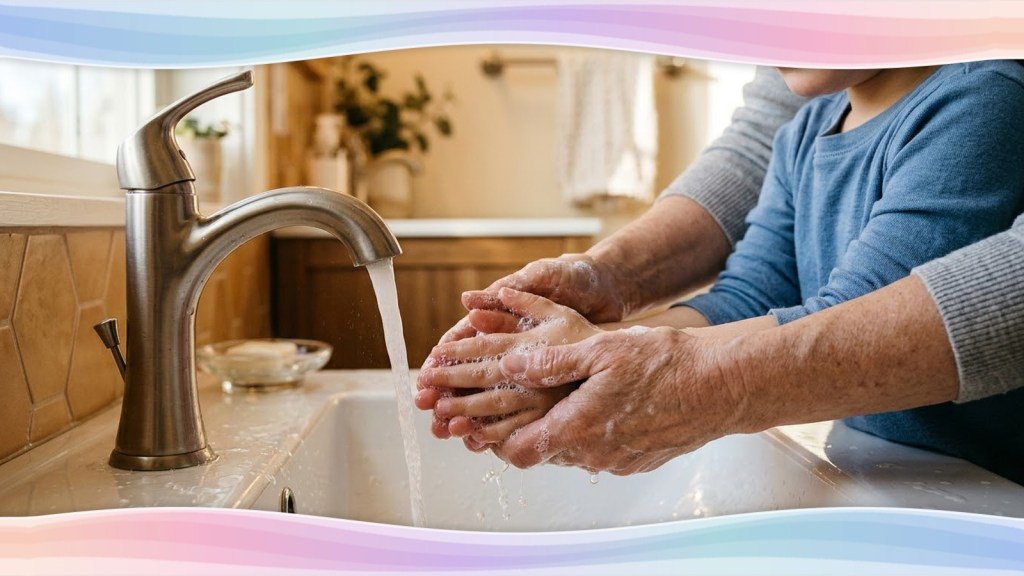
Washing hands: turn on the water → wet your hands → add soap → rub your hands → rinse them → turn off the water → dry your hands.
Putting on a T-shirt: find the T-shirt → turn it so the label is at the back → head through the opening → right arm → left arm → pull it down.
Brushing teeth: take the toothbrush → put on a little toothpaste → brush the top → brush the bottom → rinse with water → rinse the toothbrush.
Every child is different. If a step is too big, split it in two.
Three ways to link the steps
- From the end (backward chaining). You do all the steps, and your child does only the last one. Once they’ve mastered it, they also do the second-to-last, and so on. The advantage is that your child always finishes the task and feels the success. BeyondAutism gives the T-shirt example: first, the child learns only to pull it down.
- From the beginning. Your child does the first step, you help with the rest, and the next step is gradually added.
- The whole task. Your child goes through the whole sequence every time, with help where needed.
AFIRM describes all three approaches, with examples like washing hands and putting on a jacket. There is no single “right” one. Choose what suits your child best, and if they work with a special educator, agree on the same approach.
Pictures help
Stick up the steps as pictures where the skill happens: above the sink, on the wardrobe door. Raising Children Network notes that a visual schedule can show the steps of a single task, not just the activities of the day. If you already use a visual schedule, this is the same principle, just broken down into smaller pieces.
Help that gradually fades
At first you may need to guide your child’s hands. Then you just point. Then you only point to the picture. The goal is to reduce your help little by little, so that your child doesn’t get used to always waiting for you to help.
Motivation
- Turn it into a game. BeyondAutism suggests, for example, a “search” for the hand that got “lost” in the sleeve, or pretending you “don’t know” how to do it so your child can show you.
- “First – then”. First brush teeth, then a favourite story.
- Praise every step. Be specific: “Well done, you turned on the water all by yourself!”
When the senses get in the way
The taste of the toothpaste, the feel of the brush, the sound of the water, a rough fabric. For some children, that is the main obstacle, not the skill itself. SA Dental, the public dental service of South Australia, suggests, for example, gently touching the cheeks and lips first, and only then the teeth. Try small changes: a different brush, a different toothpaste, a softer towel, clothes without labels. If the difficulty is significant, talk to a dentist or the professional who works with your child. Another option: let your child choose the toothbrush and toothpaste themselves, for example between two that you offer. When they have a choice, children often feel pleased and are more motivated to use them.
Common mistakes
- Too many steps at once. One new step is enough.
- A different order every day. When the order is always the same, your child remembers it more easily.
- Doing it for them when we’re in a hurry. It’s understandable, but if it happens every day, learning stops. Choose one calm moment in the day for practice.
- Giving up too soon. Some skills take weeks.
You are not alone
If you read Macedonian, the parents’ handbook by the Macedonian Scientific Society for Autism has a dedicated section on establishing routines. If your child works with a special educator, speech therapist or other professional, show them your steps. When everyone teaches the same thing in the same way, the child makes faster progress.
Which skill is hardest for you at home? Write to us. Questions like these help us know what to write about next.
Sources and further reading
- Sam, A. and AFIRM Team (2024). Task Analysis: EBP Brief Packet. FPG Child Development Institute, University of North Carolina at Chapel Hill.
- Steinbrenner, J. R. et al. (2020). Evidence-Based Practices for Children, Youth, and Young Adults with Autism. NCAEP, UNC.
- BeyondAutism (United Kingdom): Teaching self-help skills.
- Raising Children Network (Australia): What are visual supports and visual schedules?
- SA Dental, public dental service of South Australia: Children on the autism spectrum.
- Trajkovski, V. and Vasilevska Petrovska, I. (2020). Supporting social skills and positive parenting. Macedonian Scientific Society for Autism, Skopje. (in Macedonian)
Share this article:
ℹ️ Important note. The content of this article is intended for general information only and does not constitute medical, therapeutic or other professional advice. It does not replace assessment, diagnosis or treatment by a doctor, special educator, speech therapist or other professional who knows your child. Every child is different, and what helps one child may not help another. If you have concerns about your child’s health, development or behaviour, contact a professional. Links to external pages are provided for additional information. The Aurora Lumina association is not responsible for their content and does not control it. The information and links were checked on the date of publication and may change over time.


Leave a Reply