
* This article was translated from Macedonian with the help of artificial intelligence (AI).
When there is an autistic child in the family, a lot of time and energy goes to them. That is normal. But brothers and sisters are watching, listening and feeling too. Here is how to help them understand and feel seen.
What brothers and sisters feel
Raising Children Network, Australia’s national parenting website, notes that siblings may feel jealous, left out, embarrassed, angry about unfairness, guilty or worried, and often feel they need to protect their brother or sister. Most often, they feel more than one of these at once.
The UK organisation Sibs, dedicated specifically to brothers and sisters of disabled children, warns that they often get less attention from their parents and have more worries and responsibilities than their peers. This doesn’t mean you are doing something wrong. It means it is worth paying attention.
When and how to explain
- Start early. Raising Children Network advises starting as soon as the child can understand, or as soon as they notice that their brother or sister behaves differently.
- Simple words. For a young child, this is enough: “Marko’s brain works a little differently. Loud sounds feel very strong to him. That’s why he sometimes covers his ears.”
- Clear up their fears. Young children sometimes think it is their fault, because of something they did or thought. Tell them clearly that it isn’t.
- Talk about strengths too. Not just what is hard for them, but what they love, what they are good at, what makes you laugh.
- Explain more than once. The questions change with age. It isn’t one conversation, but many small ones.
Children’s stories help. The UK’s National Autistic Society recommends, for example, a Sesame Street picture book and materials from the children’s channel CBeebies for young children with a brother or sister on the spectrum.
All feelings are allowed
- Listen without judging. If a child says “I don’t love him”, it usually means “this is hard for me and I need you”. You can say: “I’m not angry with you. Tell me what happened.”
- Share your own feelings too. When you say “I get tired sometimes too”, your child learns that their feelings are normal as well.
- Give them a way to express themselves. Drawing, play, a chat before bed.
Time just for them
It doesn’t have to be a big outing. Raising Children Network advises a little time alone with each child every day, even a few minutes when you simply listen. Now and then, plan something special, and if you can, have a trusted adult stay with your autistic child during that time.
Fun together
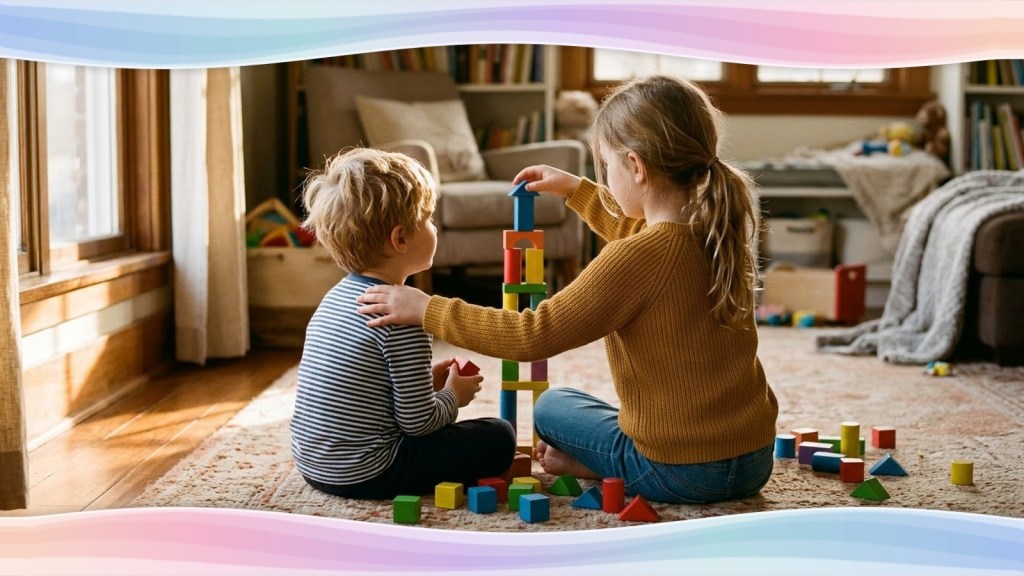
Look for activities all your children enjoy: trains, blocks, music, a ball, water. They don’t have to play “like other children”. Even sitting side by side with the same toy is a way of connecting.
The same rules for everyone
- Rules should apply to all the children, as far as possible.
- If you don’t accept a behaviour from one child, don’t accept it from the other either, hitting for example.
- Every child should have age-appropriate chores. But don’t put the brother or sister in the role of a “little parent”.
- Protect their space and their things. A shelf the younger child can’t reach, or a box just for their most important toys, can mean a lot.
Support outside the family
Raising Children Network notes that support groups help siblings see that they are not alone, and friendships outside the family help them be more than “the brother or sister of an autistic child”. If a child is sad, angry or withdrawn for a long time, talk to a paediatrician or a psychologist.
How do you talk with your children about autism? What has helped them understand? Write to us.
Sources and further reading
- Raising Children Network (Australia): About siblings of autistic children.
- National Autistic Society (United Kingdom): Family relationships – a guide for siblings of autistic people.
- Sibs (United Kingdom), the charity for brothers and sisters of disabled children and adults: sibs.org.uk.
Share this article:
ℹ️ Important note. The content of this article is intended for general information only and does not constitute medical, psychological or other professional advice. It does not replace assessment or advice from a paediatrician, psychologist, special educator or other professional who knows your family. Every family is different, and what helps one may not help another. Links to external pages are provided for additional information. The Aurora Lumina association is not responsible for their content and does not control it. The information and links were checked on the date of publication and may change over time.


Leave a Reply