
* This article was translated from Macedonian with the help of artificial intelligence (AI).
Many families say the hardest moments of the day are not the activities themselves, but the move from one to the next. A visual schedule is a simple way for a child to know in advance what comes next. Here is how to get started at home.
Why it helps
For many children on the spectrum, uncertainty is exhausting. When they don’t know what comes next, every change can feel like a surprise, and surprises often bring stress, protest or withdrawal. Words disappear the moment we say them, but a picture stays on the wall. The child can go back to it as many times as they need.
Visual supports, including visual schedules, are among the practices with the strongest research support for autistic children and young people. The major research review by the National Clearinghouse on Autism Evidence and Practice (NCAEP) at the University of North Carolina, which covers studies published from 1990 to 2017, lists them among 28 evidence-based practices. A scoping review published in the journal Autism, focused specifically on visual supports at home and in the community, notes that they are recommended in clinical guidelines for autism and can reduce anxiety, increase predictability and support communication. That does not mean they will work the same way for every child, but it does mean they are worth trying.
Which format to choose
There is no single “right” schedule. According to Raising Children Network, Australia’s national parenting website, a visual schedule can be made of objects, drawings, photos or pictures on a device, arranged in order. Choose whatever your child understands most easily:
- Objects: for younger children, or for children to whom pictures don’t yet mean much. A spoon means eating, a small toothbrush means brushing teeth.
- Photos: real pictures from your home, of their cup, their backpack, the school entrance. The more familiar, the better.
- Drawings or symbols: once the child recognises pictures. You can draw them yourself or use ready-made ones.
- A written list: for children who read. Many teenagers and adults use exactly this kind of schedule, on paper or on their phone.
If you’re not sure where to start, start with the simplest one: “first – then”. Two pictures side by side: first wash hands, then snack. That is the first schedule for many children.
How to make one, step by step
- Pick one part of the day. Not the whole day. Start with the morning, coming home from school, or the evening before bed, whichever is hardest for you.
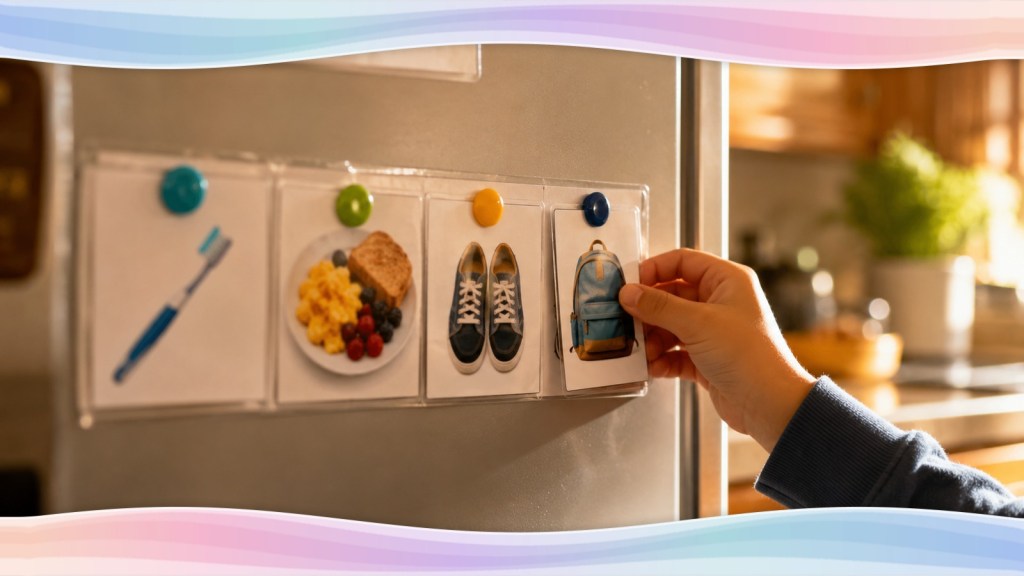
- Break it into 3–4 steps. For example: getting dressed → breakfast → shoes → off we go. You can add more later, but at the start, less is better.
- Make the cards. Take photos of the activities, print them, and if you can, laminate them or put them in clear sleeves. Velcro or magnets on the back help a lot.
- Put it in a fixed place, at your child’s eye level: the fridge, a bedroom door, a hallway wall.
- Go through it together. For the first few days, stand next to your child, point to the picture, name it in a word or two (“now – breakfast”) and do the activity.
- Mark it “done”. When the activity is finished, the child removes the card, turns it over or ticks it off. That small moment of finishing often gives them a sense of satisfaction.
- End with something nice. If the last step is a favourite activity, the whole sequence makes sense.
If you’d like a more detailed guide for parents, the Indiana Resource Center for Autism (IRCA) at Indiana University has an article dedicated to schedules at home, for both children and adults on the spectrum.
What about changes?
Life doesn’t always follow the schedule: the doctor is running late, grandma drops by unexpectedly, the park is closed. This is exactly where the schedule helps most, if you show the change in advance.
- Make a special “change” or “surprise” card, for example with a star or a question mark. Over time, your child will learn that change is part of the schedule, not the end of the world.
- When you know something will change, swap the picture before that moment comes, and tell your child.
- When a change is unexpected, go back to the schedule as soon as you can and show what comes next now.
Common mistakes
- Too many steps at once. A schedule with 15 pictures is hard even for an adult.
- Using it only on bad days. A schedule works best when it is part of every day, not a tool for “putting out fires”.
- Pictures the child doesn’t recognise. If there’s no response, try something more concrete: a photo instead of a drawing, an object instead of a photo.
- Using the schedule as a punishment. It is there to help the child know what comes next, not to force them.
- Giving up too soon. Many children need a few weeks before the schedule becomes a habit.
As your child grows
The schedule can grow with your child. From objects to photos, from photos to words, from the fridge to a notebook or a calendar on the phone. The goal is not for the schedule to disappear, but for the child to use it more and more on their own. Many adults, on the spectrum or not, couldn’t organise their day without their calendar.
It doesn’t have to be perfect
You don’t need expensive materials or special training to start, as Raising Children Network also points out. You need a sheet of paper, a few pictures and a little patience. If your child works with a special educator, speech therapist or teacher, show them what you do at home and ask for their advice. When the same system is used at home and elsewhere, the child accepts it more easily.
What matters is that it happens every day.
If you read Macedonian, the Macedonian Scientific Society for Autism (MSSA) has published a handbook for parents, available free of charge in the repository of Ss. Cyril and Methodius University. It has dedicated sections on visual support, establishing routines and sensory sensitivity.
Do you use a visual schedule at home? What helped, and what didn’t? Write to us. We learn from your experiences, and so do other parents.
Sources and further reading
- Trajkovski, V. and Vasilevska Petrovska, I. (2020). Supporting social skills and positive parenting: a handbook for parents of children with autism spectrum conditions and professionals in their support circle. Macedonian Scientific Society for Autism, Skopje. (in Macedonian)
- Steinbrenner, J. R. et al. (2020). Evidence-Based Practices for Children, Youth, and Young Adults with Autism. National Clearinghouse on Autism Evidence and Practice, FPG Child Development Institute, University of North Carolina at Chapel Hill.
- Rutherford, M. et al. (2020). Visual supports at home and in the community for individuals with autism spectrum disorders: A scoping review. Autism, 24(2), 447–469.
- Raising Children Network (Australia): What are visual supports and visual schedules?
- Indiana Resource Center for Autism, Indiana University: article on visual schedules for parents.
- AFIRM, FPG Child Development Institute, UNC: Visual Supports, a short overview from the visual supports module.
Share this article:
ℹ️ Important note. The content of this article is intended for general information only and does not constitute medical, therapeutic or other professional advice. It does not replace assessment, diagnosis or treatment by a doctor, special educator, speech therapist or other professional who knows your child. Every child is different, and what helps one child may not help another. If you have concerns about your child’s health, development or behaviour, contact a professional. Links to external pages are provided for additional information. The Aurora Lumina association is not responsible for their content and does not control it. The information and links were checked on the date of publication and may change over time.


Leave a Reply